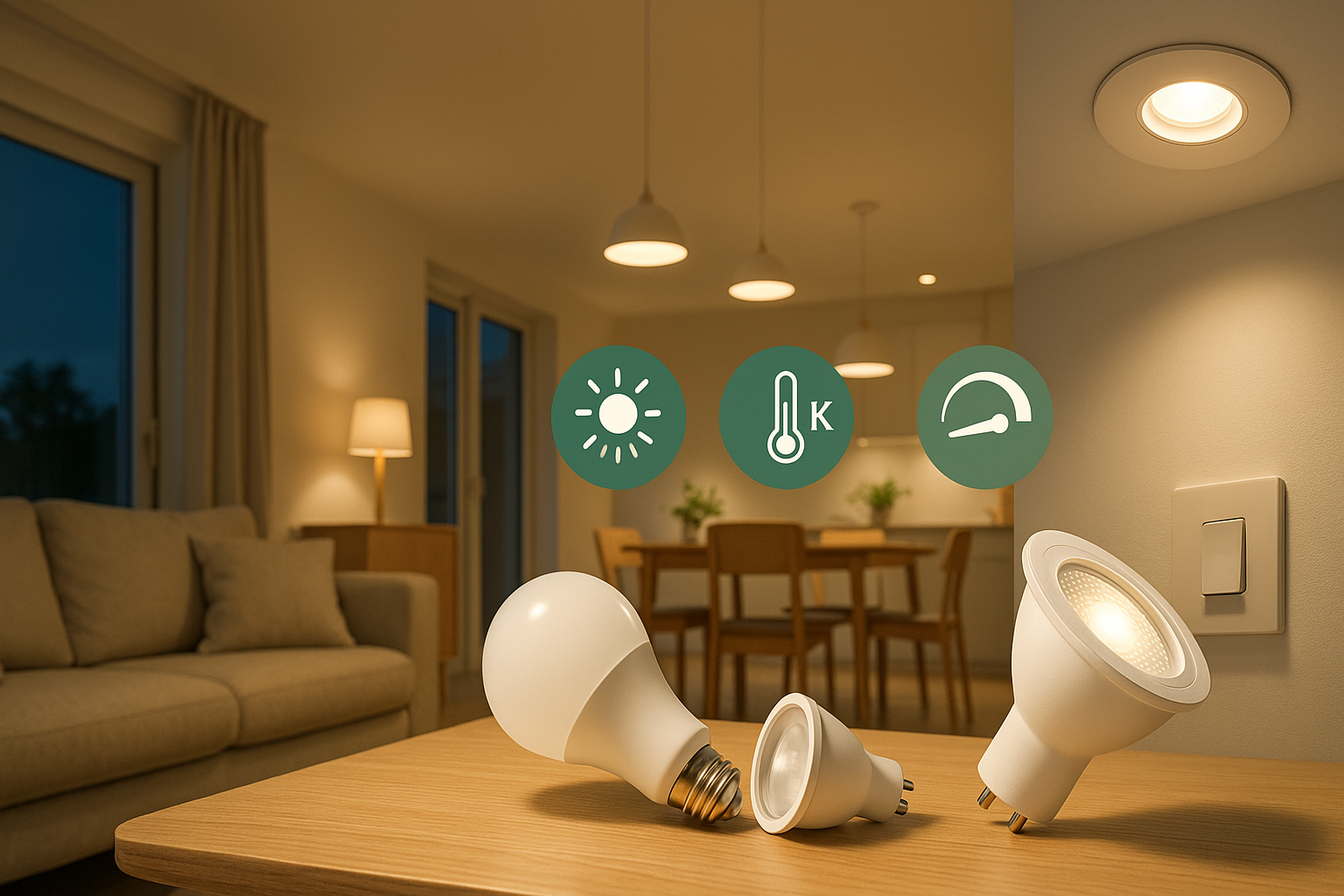
Why LEDs now
- Major savings: a 50 W halogen to 5 W LED cuts 90% for the same light.
- Cooler & safer: far less heat in ceilings and fittings.
- Long life: quality LEDs last 15 000–50 000 hours if well-cooled.
- Driver quality matters: cheap lamps flicker and fail early; buy reputable brands.
How to choose bulbs
| Spec | What to look for | Notes |
|---|---|---|
| Base / Voltage | E27/B22 230 V, GU10 230 V, MR16 12 V | MR16 needs a good 12 V driver; many convert MR16 → GU10 to simplify. |
| Brightness | Use lumens not watts | 60 W incandescent ≈ 800 lm; 50 W halogen ≈ 400–500 lm. |
| Colour temp | 2700–3000 K warm, 3500–4000 K neutral, 5000 K cool | Warm for lounges/bedrooms; neutral for kitchens/offices. |
| CRI | CRI ≥80 good, ≥90 premium | Higher CRI renders colours more naturally. |
| Dimmable | Only if stated | Match LED-rated dimmers; check minimum load to avoid flicker. |
| Beam angle | 36–60° downlights, 200° globes | Narrow beams for accents, wide for general lighting. |
| Surge / driver | Look for surge rating and warranty | SA grid spikes can kill cheap drivers. |
Room-by-room quick picks
| Space | Target lumens | Colour temp | Typical LED |
|---|---|---|---|
| Lounge / bedroom | 100–200 lm/m² ambient | 2700–3000 K | 8–10 W A60 globe or 4–6 W GU10 |
| Kitchen / study | 300–400 lm/m² task | 3500–4000 K | 10–12 W bright globe or 6–7 W GU10 |
| Bathroom | 200–300 lm/m² | 3000–4000 K | IP-rated fittings where needed |
| Outdoor / security | Area dependent | 4000–5000 K | 10–30 W LED flood with sensor |
Use more fixtures at lower power for smoother light rather than a few high-power points.
Costs & payback
| Swap | Old | New | Savings | Example payback |
|---|---|---|---|---|
| Halogen downlight → LED | 50 W × 3 h/day | 5–6 W × 3 h/day | ≈45 W per fitting | At R3.00/kWh, ≈R150–R200/year saved per lamp; LED under R100 pays back in ~6–12 months. |
| Incandescent globe → LED | 60 W × 3 h/day | 8–9 W × 3 h/day | ≈52 W per fitting | ≈R170–R220/year saved; typical payback ~6–12 months. |
Your tariff and hours drive the result. Longer burn hours accelerate payback.
Smart controls that boost savings
- Motion sensors: auto-off in passages, bathrooms and outdoors.
- Schedules / scenes: dim in the evenings; daylight-based on/off.
- Wall smart switches: keep normal bulbs but add control; ensure neutral-wire requirement is met.
- Surge protection: add SPD at DB to protect sensitive drivers and smart gear.
Installation & compliance (South Africa)
- Max lamp rating: never exceed the fitting’s rated wattage; LEDs run cooler but rating still applies.
- Enclosed fittings: buy “enclosed-rated” lamps to avoid heat-stress failures.
- Downlights: keep clearances in ceilings; use fire-rated cans where specified.
- MR16 to GU10: if converting to 230 V, use a qualified electrician and remove old transformers safely.
- Dimmers: use LED-rated dimmers; match brand lists where possible to avoid flicker.
- Certificates: material changes to fixed wiring should be covered by a valid CoC.
- Audit rooms. Note base types, quantity, hours of use.
- Replace high-hour lamps first: kitchen, lounge, outdoor security.
- Standardise on colour temps by area to avoid mismatched light.
- Add motion sensors to low-traffic zones.
- Protect with a surge device at the DB.
FAQ
Do LEDs work with my old dimmer?
Only if both lamp and dimmer are compatible. Replace legacy dimmers with LED-rated models for stable low-level dimming.
Why do some LEDs flicker?
Poor drivers, incompatible dimmers, or low minimum load. Choose quality brands and correct dimmer types.
Will LEDs reduce my solar/battery size?
Yes. Lighting becomes a small fraction of load, freeing capacity for appliances and reducing battery depth of discharge.
This guide is informational. Follow manufacturer instructions, SANS standards and municipal by-laws; use a qualified electrician for fixed-wiring work and CoC.