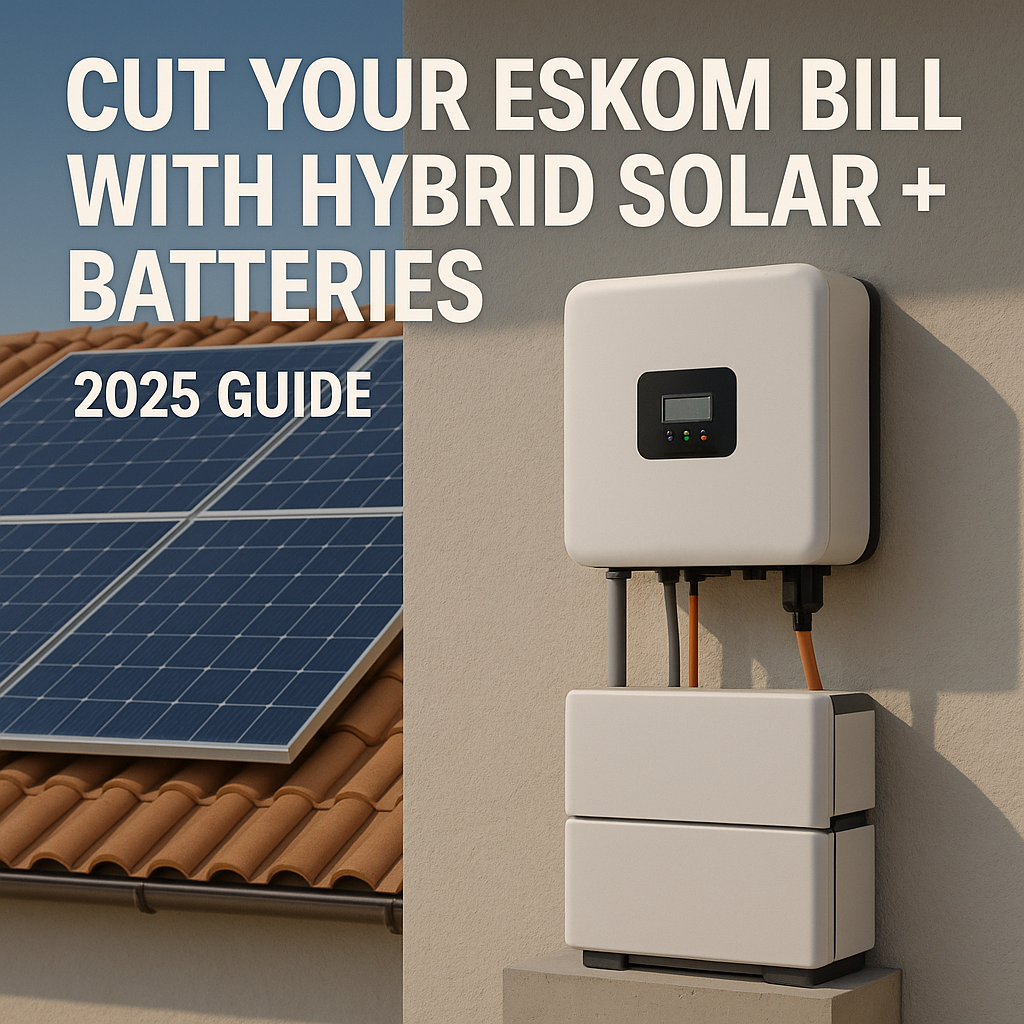
What is a hybrid system?
A hybrid setup combines PV panels, a hybrid inverter, a lithium battery, and the grid. Solar runs daytime loads first, surplus charges the battery, and the battery supplies evening or outage power. The grid fills gaps.
Self-consumption Time-of-use shifting Backup during load-shedding
Savings math
Estimate monthly savings with three variables: displaced daytime kWh, shifted evening kWh from battery, and avoided generator fuel.
| Component | How to estimate | Typical share |
|---|---|---|
| Day self-use | PV kWh used directly by loads | 40–60% |
| Evening shift | Battery kWh discharged 18:00–22:00 | 30–50% |
| Fuel avoided | Diesel spend replaced by solar/battery | 0–20% |
Back-of-envelope: Savings ≈ (PV self-use kWh + battery discharge kWh) × your blended R/kWh. Use your utility bill’s rate.
Match to your load profile
- Daytime home: larger PV, moderate battery.
- Evening-heavy: moderate PV, larger battery.
- Work-from-home + pool: add smart scheduling for pumps and geysers.
- Apartment: small PV where allowed, 5–10 kWh battery for outages.
Proven home configs
| Home type | PV array | Inverter | Battery | Outcome |
|---|---|---|---|---|
| Essentials | 3–4 kW | 5 kW hybrid | 5–10 kWh | Lights, Wi-Fi, TV, fridge during outages |
| Family | 5–8 kW | 8 kW hybrid | 10–15 kWh | Evening shift + moderate appliances |
| Large home | 8–12 kW | 12 kW hybrid | 20–30 kWh | Near off-grid evenings |
Costs & ROI
- Entry: R80k–R140k (5 kW + 5–10 kWh).
- Family: R140k–R220k (8 kW + 10–15 kWh).
- Large: R220k–R350k (12 kW + 20–30 kWh).
ROI improves with higher tariffs, good north-facing roof, and smart load scheduling. Finance options include green loans and rent-to-own.
Popular SA brands
Inverters: Sunsynk, Deye, Victron, Huawei.
Batteries (LFP): Dyness, Hubble, Pylontech, Freedom Won, EcoFlow.
Installer checklist
- Full load audit and roof survey with shading report.
- Battery sizing for two evening cycles in heavy load-shedding.
- Essential vs non-essential sub-DB split with labels.
- Surge protection and correct earthing verified.
- Commissioning sheet and monitoring app handover.
Compliance & tariffs
- Municipal registration required for grid-tied/hybrid. Submit single-line diagram and inverter spec sheet.
- CoC on completion. Keep for insurance and resale.
- SANS 10142-1-2 applies to PV wiring rules.
- Feed-in available in select metros. Else run self-consumption mode.
Common mistakes
- Undersized battery causing night grid draw.
- Oversized inverter with tiny PV array.
- No geyser or pool pump scheduling.
- Poor cable routing and inadequate ventilation.
FAQ
Do I need panels on day one?
You can start battery-only with a hybrid inverter, then add panels. Savings improve once PV is added.
How much battery for a 3-bed home?
10–15 kWh covers typical evening loads if you manage heavy heaters and ovens.
Can I go off-grid?
Yes, but costs rise fast. Most homes do best on hybrid self-consumption with backup.
Informational only. Use registered electricians, follow SANS 10142-1-2 and your municipality’s SSEG rules.