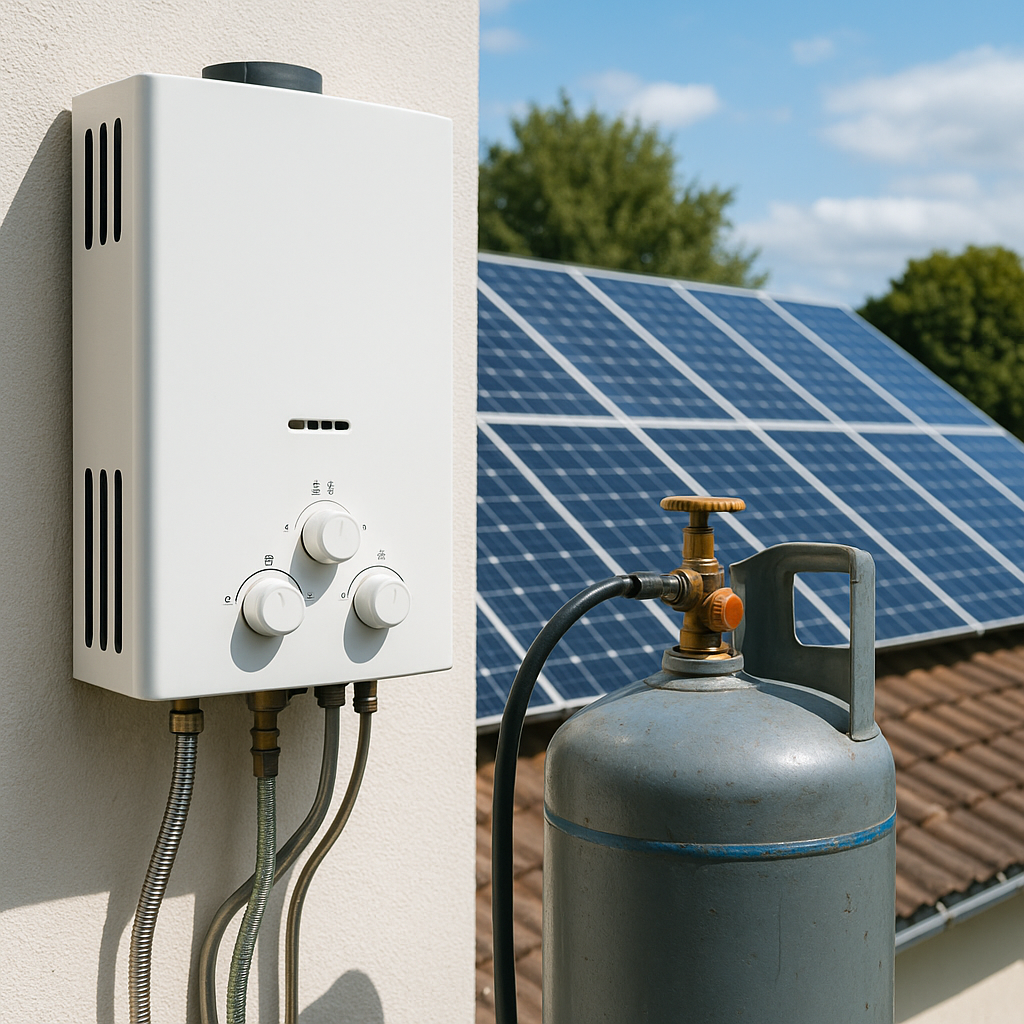
Why LPG for hot water?
- Cuts electric load: frees 3 kW+ element demand from your inverter/battery.
- No standing losses: heats only when you open a tap; nothing to keep hot all day.
- Load-shedding proof: hot water regardless of grid availability.
- Needs bottled gas & ventilation: safe placement and compliant install are essential.
How LPG geysers work (instant/on-demand)
An LPG geyser senses water flow, opens a gas valve and ignites a burner. Water passes through a heat exchanger and exits at the set temperature. There’s no tank, so heat is only produced when needed.
Sizing by flow rate (L/min)
Pick a model by simultaneous hot-water demand and inlet water temperature.
| Household scenario | Suggested size | Notes |
|---|---|---|
| 1 bathroom, kitchen sink | 10–12 L/min | Good for singles/couples; one shower at a time. |
| 2 bathrooms (not concurrent) | 12–16 L/min | Comfortable one shower + basin use. |
| 2 bathrooms used at once | 16–20 L/min | Pick higher end for winter inlet temps. |
| 3+ bathrooms / large family | 20–26 L/min | Consider two units in parallel for redundancy. |
Colder winter mains water means you’ll need more burner power to reach the same outlet temperature.
Costs & running comparison
| Item | Electric storage geyser | LPG instant geyser |
|---|---|---|
| Upfront unit | R5 000–R8 000 | R4 000–R7 000 |
| Install (typical) | R3 000–R8 000 | R4 000–R10 000 (gas piping, cage, regulator) |
| Monthly running | R800–R1 200 (Eskom) | R600–R900 (LPG usage dependent) |
| Solar impact | Large inverter/battery needed to run element | Offloads hot water from solar/battery |
Actuals vary by usage, tariffs and LPG price. Many homes still see lower monthly cost with LPG vs grid electricity for hot water.
Installation & compliance (South Africa)
- Registered installer: SAQCC Gas–registered technician required for legal, safe installs.
- Gas storage: Bottles upright, outdoors, in a ventilated cage with signage and shut-off valves.
- Ventilation/flue: Follow manufacturer and SANS 10087; many units must be outdoors or flued.
- Water pressure: Some sites need a pressure regulator or small booster pump.
- Certificates: Gas CoC; update your home insurance with install details.
Hybrid options (solar thermal + LPG)
Pair an evacuated-tube or flat-plate solar thermal tank with an LPG instant heater as backup. On sunny days, solar thermal supplies most heat; in cold or high-demand periods, LPG tops up to setpoint. This gives very low running costs with full reliability.
- Small home: 12–16 L/min LPG unit, outdoor mount, simple pipe run.
- Family home: 16–20 L/min or two smaller units split by bathrooms.
- Off-grid/solar focus: Solar thermal tank + 12–16 L/min LPG booster.
FAQ
Will my showers be weaker?
Not if sized correctly. Flow-rate governs how many outlets you can use at once. Check your site pressure and choose L/min accordingly.
Can I keep my existing electric geyser as backup?
Yes. Some households keep the tank for rare use and run daily hot water on LPG, or migrate fully and remove the old tank.
What does this mean for solar PV sizing?
By removing a 3 kW element load, you can downsize batteries/inverters and use PV mainly for plugs, lights and appliances — often the most cost-effective path.
How often will I refill LPG?
Depends on family size and shower habits. Many homes rotate two 48 kg bottles; a set can last 1–3 months with typical use.
This guide is informational. Always use a SAQCC-registered LPG installer and comply with SANS standards and municipal by-laws.