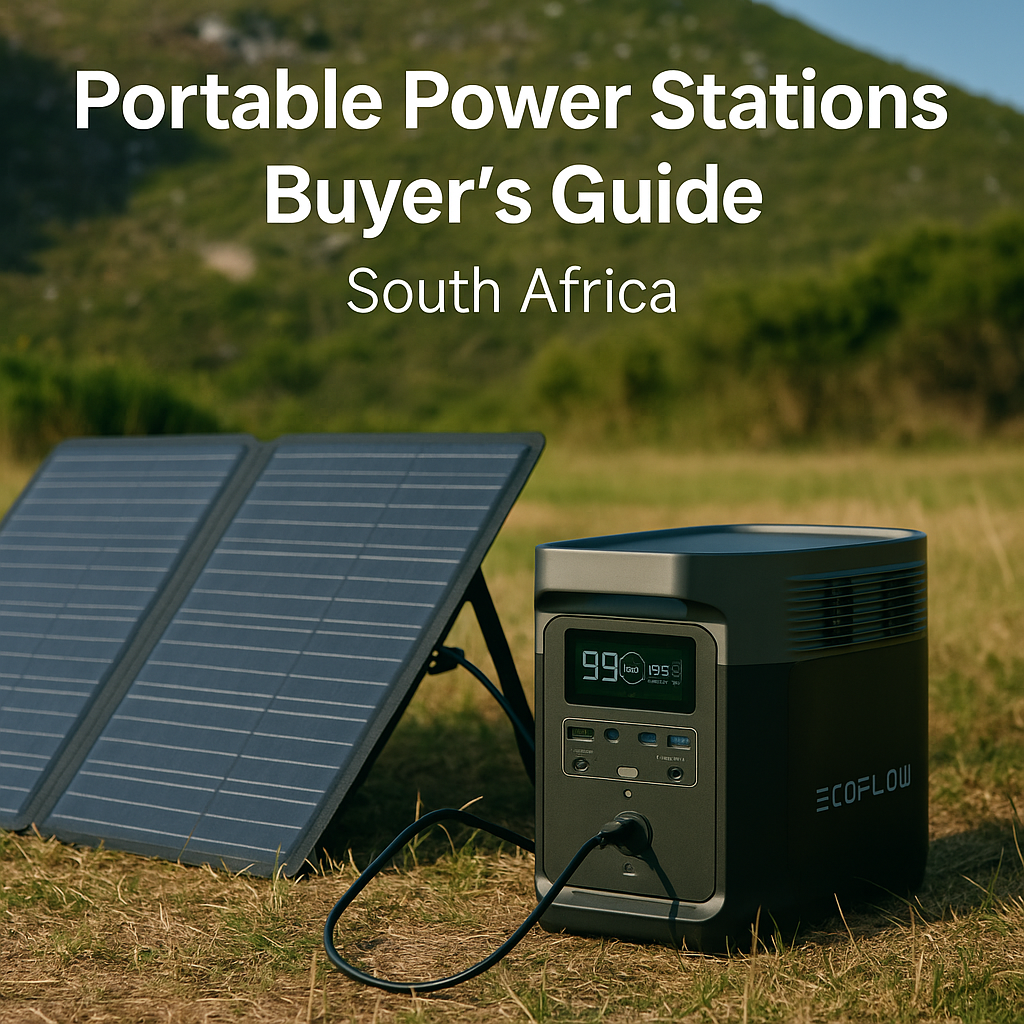
What is a portable power station?
A portable power station (PPS) is a rechargeable battery with an inverter and multiple outputs (AC sockets, USB, 12V). It replaces small generators for home backup, camping, events, and mobile work. Many accept solar input for off-grid charging.
How to size: watt-hours (Wh) and watts (W)
- Energy (Wh): Rough runtime ≈ Wh ÷ device watts × efficiency (use 0.85 as a rule). Example: a 60 W router + ONT on a 300 Wh unit ≈ (300 ÷ 60 × 0.85) ≈ 4.25 hours.
- Power (W): Inverter continuous watts must exceed your largest simultaneous load. Leave headroom for startup surges.
- Tiering: 250–400 Wh = small electronics; 700–1200 Wh = routers, laptops, a TV; 1.5–2.5 kWh = fridges, power tools, longer backup.
Key specs to compare
| Spec | What to look for | Why it matters |
|---|---|---|
| Battery chemistry | LFP (LiFePO₄) preferred | More cycles and thermal stability than NMC in most use cases. |
| Cycles to ≥80% | ≥ 3,000 cycles good; higher is better | Determines long-term value. |
| Inverter output | Pure sine; enough W + surge | Compatibility with sensitive electronics and motor starts. |
| UPS/transfer | Fast switchover | Keeps PCs/routers online during outages. |
| AC recharge | Fast, no brick if possible | Convenience. EcoFlow is strong here. |
| Solar input | Built-in MPPT; check max W/V | Faster daylight charging and off-grid use. |
| I/O ports | USB-C PD, multiple AC, 12V regulated | Fewer adapters, better efficiency. |
| Expandability | Extra batteries supported | Scale up later without replacing the unit. |
| Warranty & app | Local support + useful app | Settings, updates, and after-sales. |
Charging methods & solar input
- AC wall: Fastest and easiest. Some EcoFlow models charge from 0–80% rapidly.
- Solar PV: Use portable panels or roof PV within the unit’s voltage/watt limits. Built-in MPPT is important.
- 12V/car alternator: Slow but useful while driving.
Quick picks by use case (EcoFlow examples)
| Use case | Suggested capacity | EcoFlow range examples |
|---|---|---|
| Internet + phone + lights for load-shedding | 300–500 Wh, 300–600 W inverter | EcoFlow RIVER series |
| Apartment backup (router, TV, laptop, a few plugs) | 700–1200 Wh, 600–1000 W | EcoFlow RIVER high-capacity / entry DELTA |
| House backup for fridge + electronics | 1.5–2.5 kWh, 1400–2400 W | EcoFlow DELTA family |
| Workshop / events / longer outages | 2–4 kWh+, expandable, 2400 W+ | EcoFlow DELTA expandable models |
- List your loads and their watts. Add 20–30% headroom.
- Pick LFP, pure-sine inverter, built-in MPPT.
- Check solar input limits if you’ll charge from panels.
- Consider expansion batteries for future growth.
FAQ
Can a PPS run a fridge?
Yes if the inverter watts and surge allow it and you have enough Wh. Fridges cycle, so average draw is lower than the nameplate.
LFP vs NMC?
LFP generally means more cycles and stability. NMC can be lighter for the same Wh. For home backup, LFP is usually preferred.
Is a PPS a full home inverter?
No. It’s a self-contained, portable unit. Great for critical loads and mobility. For whole-home power you need a fixed inverter system.
Specs change by model. Verify capacities, inverter ratings, cycle life, and solar limits on the product page before purchase.